
Ghost Controls Gate Repair in Baldwin Park: A Homeowner’s Guide
Ghost Controls gate repair in Baldwin Park usually comes down to one of three things: a solar panel that isn’t getting enough sun, RF interference confusing the receiver, or an actuator arm that’s drifted out of adjustment. None of these mean your gate opener is junk. They mean the system was designed for open rural properties and Baldwin Park’s dense lots put different demands on it. If you’d rather skip the troubleshooting and get it diagnosed right the first visit, call (855) 679-6795.
Here’s the part most guides skip: Ghost Controls builds solid equipment, but it’s engineered for a different environment than the one we live in. The company’s roots are in rural DIY installation, where a gate opens onto acreage, the nearest neighbor is a quarter mile away, and the solar panel sits in full sun all day. Baldwin Park is none of those things. We’re a dense suburb with partial shade from mature trees, stucco walls that bounce RF signals, and enough remote controls in the air to confuse a receiver on a bad day. That mismatch creates failure patterns that look random until you know what to look for.
We work on the brand you already have, and Ghost Controls is one we see regularly across Baldwin Park driveways. This guide covers the specific issues we encounter most, how to think about them, and when a repair stops making financial sense.
Why Ghost Controls Solar Panels Underperform in Baldwin Park Yards
Ghost Controls solar kits are rated for full sun. Not partial sun, not dappled light through tree branches, not a few hours of direct exposure between neighboring rooflines. The panel needs consistent, unobstructed Southern California sun for most of the day to keep the battery topped off. In Baldwin Park, a lot of yards don’t offer that. A mature ficus on the parkway, a two-story neighbor, or even the angle of the gate relative to the sun’s arc can cut charging time short without you ever noticing.
Here’s what we see happen next: the battery never quite reaches a full charge. Ghost Controls systems run on 12V batteries, and the control board starts acting erratically once voltage drops below roughly 11.8V under load. That threshold is where phantom behavior begins. The gate opens halfway and stops. The remote works intermittently. The auto-close function gives up. Homeowners assume something broke, when really the system is just underpowered and confused.
The fix isn’t always a new battery. We start by checking actual charging output from the panel with a meter, then test the battery under load to see if it holds voltage. If the panel placement is the problem, we can relocate it, add an extension cable, or convert the system to a hardwired AC power supply using a Ghost Controls-compatible transformer. For some Baldwin Park properties with deep shade, a hybrid approach works: keep the solar panel as backup and run low-voltage wiring to a nearby outlet.
If your Ghost Controls gate works fine in the morning but limps by evening, check the voltage first. That single data point answers more questions than any amount of random button-pressing.
RF Interference: Why Your Gate Opens When Nobody Presses a Button
Every gate remote in Baldwin Park shares the same airwaves. Ghost Controls systems operate on common frequency bands, and a dense neighborhood means dozens or hundreds of transmitters within range. Garage door openers, car fobs, neighboring gate systems, home Wi-Fi routers operating on 2.4GHz, and even some LED bulbs can throw noise into the environment. The result: gates that open on their own, remotes that only work from ten feet away, and receivers that occasionally ignore commands entirely.
This is the phantom open/close cycle, and it’s more common in Baldwin Park than in the rural settings Ghost Controls gear was originally sold for. Our technicians see it most often in neighborhoods where homes are close together and several gates exist on the same block.
Thankfully, Ghost Controls gave us a tool for this. The receiver boards on most Ghost Controls units have DIP switches that set the frequency channel. Changing the DIP switch positions moves your system to a different sub-frequency, which is often enough to stop interference from a neighbor’s system. Here’s the process in general terms:
- Locate the receiver board inside the control box (power off first, and if you’re not comfortable working around electrical components, stop here and call us).
- Note the current DIP switch positions so you can return to them if needed.
- Change one or two DIP switches to a new combination.
- Reprogram all remotes to the new code sequence following Ghost Controls’ pairing procedure.
- Test the gate from various distances and angles around the property.
If changing the DIP switch position doesn’t clear it up, the next step is checking for a failing receiver board or a remote stuck in transmit mode. We’ve seen remotes wedged between seat cushions in a car parked too close to the gate, sending continuous signals for days. That’s a fun one to explain to a frustrated homeowner.
This is also where electric gate repair gets more involved than swapping a battery. RF diagnosis takes patience and the right meters. Waving parts at the problem gets expensive fast.
Actuator Arm Adjustment on Ghost Controls TTC and AC2000 Models
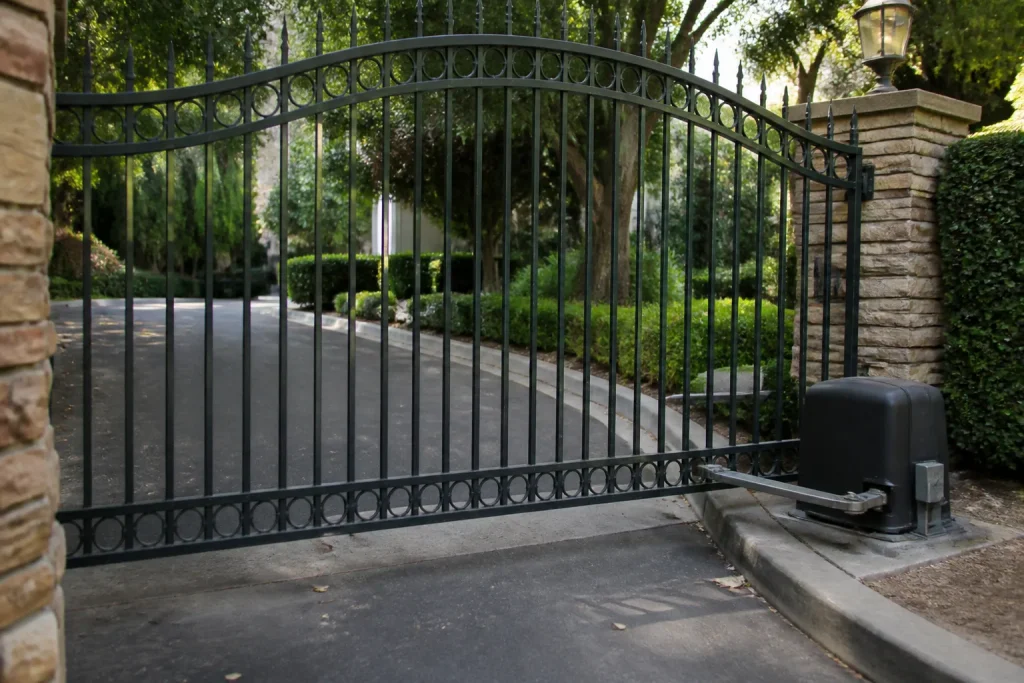
The actuator arm is the workhorse of a Ghost Controls swing gate system. It’s the metal arm that extends and retracts to push the gate leaf open and pull it closed. On TTC and AC2000 models, the arm mounts to a bracket on the gate and a bracket on the post or column. When the gate starts binding, squealing, or failing to close fully, the arm is usually where the problem lives.
The most common mechanical failure point in Baldwin Park residential installations is the actuator arm drifting out of alignment. This happens gradually. The gate settles, the posts shift slightly in expansive soil, or a vehicle nudges the gate once and throws the geometry off. A quarter inch of misalignment at the bracket is enough to make the arm work harder, wear faster, and eventually trip the system’s obstruction sensor.
Adjusting a Ghost Controls actuator arm isn’t a one-size-fits-all job. Here’s the general procedure we follow:
- Disconnect power and manually release the actuator so the gate swings free.
- Check that the gate leaf moves smoothly through its full arc without binding.
- Verify the actuator mounting brackets are square to the gate and post, not twisted or canted.
- Adjust the arm’s extension and stroke length to match the gate’s actual travel distance.
- Re-engage the actuator and run a full open/close cycle to confirm even speed and no strain.
The catch with Ghost Controls specifically is that the arm’s internal limit settings need to match the physical gate travel, and the gate’s own physical stops need to be intact. If the gate can swing too far because a stop post is missing, the arm takes the abuse every cycle. We see that exact scenario a lot in Baldwin Park on older properties where original gate stops were removed for driveway widening.
This kind of work is mechanical, but it’s also electrical at the same time. If the arm is making a grinding sound, don’t keep running the gate and hoping it works itself out. It won’t. It’ll just wear the gear train down until a repair becomes a replacement.
Limit Switch Calibration: What Ghost Controls Does Differently
Ghost Controls limit switches work differently than the ones on LiftMaster, DoorKing, or Elite systems. On many brands, the limit is set at the control board with a screw or button. Ghost Controls uses a magnetic limit system inside the actuator arm itself in many models, and the control board reads the arm’s position. That means a technician who isn’t familiar with the brand will often try to calibrate limits at the board, fail to find the setting they expect, and conclude the board is bad. It isn’t bad. They’re looking in the wrong place.
Here’s the practical difference for a Baldwin Park homeowner: if your gate stops six inches short of closed, or overshoots and slams against the stop, the issue is usually limit calibration. With Ghost Controls, that calibration lives in the relationship between the actuator arm’s internal stop positions and the physical closed position of the gate leaf. Calibrating it means setting the gate where you want it to stop, setting the arm’s internal stops to match, and then running the system through several cycles to confirm it holds consistent position.
The mistake we see generalists make is calibrating based on where the gate should be, not where it actually sits. A slightly sagging gate leaf or a settling post changes the geometry. You calibrate to reality, not to the blueprint.
If your Ghost Controls gate is opening or closing too far, it’s worth having someone who knows the brand’s quirks take a look. Standard gate repair knowledge covers the basics, but this specific calibration is where brand familiarity prevents misdiagnosis. That’s also where our focus on nine brands including Ghost Controls, LiftMaster, DoorKing, Elite, Mighty Mule, and FAAC pays off. We know what the board on each one expects to see.
When Repair Costs More Than Upgrading to a Hardwired Operator
There’s a point where continuing to repair a Ghost Controls solar system stops making sense. That point usually arrives after the second or third significant repair within a few years, or when you’re looking at replacing the actuator arm, control board, and battery at the same time. Here’s a realistic breakdown of how that math works.
A Ghost Controls actuator arm replacement runs several hundred dollars. A new control board adds more. A battery and solar panel replacement adds more still. If all three need replacement at once, you’re approaching or exceeding the cost of a new hardwired swing gate operator from a brand like LiftMaster or Elite, installed. And the hardwired system comes with a few advantages in a Baldwin Park context: consistent AC power with no solar variability, stronger RF receiver design in many cases, and local parts availability when something does fail down the road.
Now, that doesn’t mean Ghost Controls is a bad system to own. When it’s properly installed and getting enough sun, it’s a solid operator. But if your gate sits in shade and you’ve spent the last three years chasing electrical gremlins, an upgrade is worth considering. The good news is that the gate itself, the posts, the hinges, and the physical structure can all stay. You’re replacing the operator, not the gate. That’s a Gate Repair Baldwin Park specialty: we can swap the automation while keeping the gate you already paid for.
We’re brand-agnostic by design. If keeping your Ghost Controls running is the right call, we’ll say so. If a LiftMaster or a Mighty Mule makes more sense for your specific layout and shade conditions, we’ll say that too. Our job is to give you the recommendation that fits the gate, not the one that fits our inventory.
When to Call a Pro
Some things are safe to check yourself: battery voltage, obvious physical damage, loose wiring you can see without opening the control box. Other things aren’t. The control board inside a Ghost Controls unit carries live 12V DC, and while that’s lower voltage than house current, shorting the wrong terminals can fry the board or ruin a perfectly good battery. The actuator arm is also under mechanical load whenever the gate is connected, and releasing it incorrectly can cause the gate leaf to swing free faster than you expect.
If you’re dealing with phantom openings, a grinding arm, or a gate that won’t hold position, that’s a good time to bring in someone who works on Ghost Controls regularly. Especially if you’re not sure whether the problem is electrical or mechanical. Guessing wrong gets expensive.
For related help in Baldwin Park, we offer full gate installation when a system has reached the end of its useful life, and electric gate repair covers everything from control boards to loop detectors to remote systems. You never need a second company when the issue evolves from a repair into a replacement.
The Bottom Line
Ghost Controls gates in Baldwin Park fail in predictable ways once you understand the environment. Solar panels underperform in partial shade, RF interference from neighbors confuses receivers, actuator arms drift out of adjustment, and limit switches get misdiagnosed by technicians who don’t know the brand. The systems themselves are fine. The installation environment is the challenge.
If you’re dealing with a Ghost Controls gate that’s acting up, start with the battery voltage. Then check for obvious mechanical wear on the arm. If it’s still misbehaving after that, you’re probably past the DIY point and into the zone where professional diagnosis saves money.
If you’re in Baldwin Park and need help, Gate Repair Baldwin Park offers free estimates. Call (855) 679-6795. We answer 24/7. Fast dispatch from 7am to 7pm, Sunday through Friday. The price is quoted and agreed before any work starts, so you know what you’re paying for before we turn a wrench.
Frequently Asked Questions
Intermittent operation on a Ghost Controls system in Baldwin Park is usually a low battery from insufficient solar charging, or RF interference from nearby transmitters. Check battery voltage first (below 11.8V under load is a problem), then consider changing the receiver’s DIP switch frequency. If both check out, the actuator arm’s limit calibration is the next suspect.
Yes, in most cases. We dispatch technicians from 7am to 7pm, Sunday through Friday, and most Ghost Controls repairs are completed in a single visit. Call (855) 679-6795 and we’ll get someone out to diagnose it.
The price depends on what’s wrong. A simple battery replacement or DIP switch adjustment costs less than a full actuator arm replacement or control board swap. We quote the exact price after diagnosis, before any work starts, and the written estimate is what you pay. Estimates are free.
If you’re facing a single repair like a battery or a receiver board, repair is the clear choice. If the actuator arm, control board, and battery all need replacement at once, compare that total against a new hardwired operator from LiftMaster or Elite. The gate structure itself doesn’t need to change either way.
Written by the team at Gate Repair Baldwin Park, serving Baldwin Park since 2015.
Need Gate Repair Help?
Call Gate Repair Baldwin Park - licensed & insured, here with fast help in Baldwin Park.
(855) 679-6795